Core Pillars of Digital Marketing for Contractors

For HVAC contractors, securing a consistent stream of high-quality leads is essential for sustained business growth. In the dynamic home services landscape, we know that effectively reaching potential customers who need heating and cooling services, whether for routine maintenance or urgent repairs, can be a significant challenge. Many companies struggle to efficiently get HVAC leads from their local area, leading to inconsistent schedules and missed opportunities. This comprehensive guide will explore effective digital marketing channels, optimization strategies, and conversion techniques, all grounded in a data-driven digital marketing approach, designed to help your HVAC business thrive in 2026 and beyond.
Building a robust lead generation strategy for HVAC businesses involves a multi-faceted approach, leveraging various digital channels to maximize visibility and capture customer intent. Our goal is to ensure your services are found precisely when and where potential customers are looking for them. This requires understanding the digital ecosystem where homeowners search for solutions, from initial queries to urgent service calls.
Local SEO and Google Business Profile Optimization
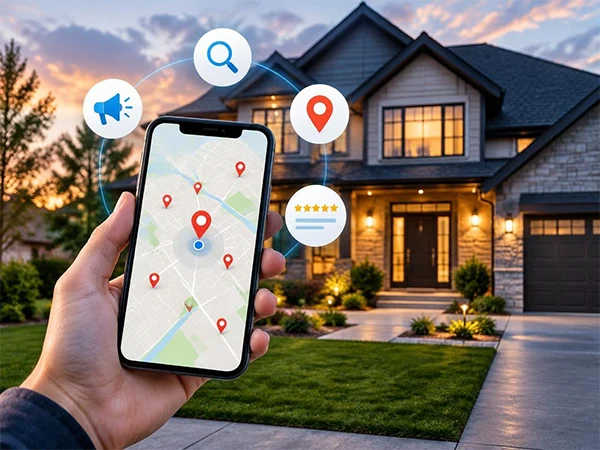
For home service contractors, Google is often the primary gateway for new business. Optimizing your presence for local search is paramount. This begins with your Google Business Profile (GBP), which serves as your digital storefront on Google Maps and in local search results. A well-optimized GBP can significantly improve your visibility in the “local pack” – the prominent map section at the top of local search queries.
Key to this optimization is maintaining consistent Name, Address, and Phone number (NAP) information across all online directories. We also recommend creating geo-targeted pages on your website, focusing on specific cities or neighborhoods you serve, to capture highly localized search intent. Implementing service schema markup helps search engines understand the specific HVAC services you offer, further enhancing your relevance. Actively managing and encouraging customer reviews is also critical; a high volume of positive reviews, coupled with prompt responses, boosts your GBP ranking and builds trust. Finally, building local citations through various online directories reinforces your local presence and authority.
High-Intent Search Ads and Local Services Ads
While organic visibility through SEO is a long-term play, paid advertising provides immediate exposure, especially for urgent service calls. Google Ads (PPC) allows us to target high-intent keywords like “AC repair near me” or “furnace installation,” ensuring your business appears at the top of search results. Effective PPC campaigns require meticulous keyword research, including both high-volume and niche terms, and strategic use of negative keywords to filter out irrelevant searches, optimizing your ad spend.
Even higher in the search results, above traditional PPC ads, are Google Local Services Ads (LSAs). These “pay-per-call” ads are particularly effective for HVAC contractors because you only pay when a homeowner calls through the ad. LSAs also feature the coveted “Google Guaranteed” badge, which signals trust and reliability to potential customers, as Google verifies licensing, insurance, and conducts background checks. For urgent service needs, where homeowners are often in a crisis, the immediate visibility and trust offered by LSAs can be invaluable. Strategic bid management for both PPC and LSAs ensures you’re competitive for critical emergency keywords while managing your budget effectively.
Optimizing the Trade Service Conversion Pipeline
Generating leads is only half the battle; converting those leads into booked appointments is where revenue is realized. An optimized conversion pipeline ensures that every visitor to your digital assets has a clear, frictionless path to becoming a customer. This involves focusing on the user experience from the moment they land on your site to the point of contact.
Website Performance and Mobile-First CRO
In today’s mobile-first world, your website’s performance is paramount. More than half of all HVAC-related searches occur on mobile devices, making a responsive and fast-loading site non-negotiable. Websites that load in under one second significantly outperform those that take longer, as users often abandon sites that don’t load quickly. We focus on optimizing page speed and Core Web Vitals to provide a seamless user experience.
Some digital marketing experts advocate for hand-coded website designs, which can offer advantages in terms of being lightweight and highly customizable, potentially leading to faster load times and precise technical SEO control compared to template-based platforms. Key conversion rate optimization (CRO) elements include prominent “tap-to-call” buttons for mobile users, clear calls-to-action (CTAs), and easy-to-use online booking forms. Integrating social proof, such as customer testimonials and reviews, directly into your landing pages can also significantly boost trust and conversion rates. Implementing call tracking software allows us to monitor which marketing channels are driving phone calls, providing valuable data for optimization.
Implementing Digital Marketing for Contractors with CRM Automation
Once a lead is generated, rapid and efficient follow-up is crucial. This is where Customer Relationship Management (CRM) systems and automation become indispensable for HVAC contractors. An integrated CRM can facilitate instant dispatch of leads to technicians, ensuring quick response times that are often critical for urgent HVAC needs.
Automated SMS follow-up sequences can engage leads immediately, providing necessary information or confirming appointments. Advanced systems can even employ AI qualification to pre-screen leads, asking pertinent questions about system type, urgency, and budget before a human agent intervenes. This ensures that your team focuses on high-intent prospects. Automated callbacks can also be configured for missed calls or unresponded inquiries, drastically improving lead capture rates. The goal is to reduce the time from inquiry to booked appointment, as studies show that responding to leads within minutes can significantly increase conversion rates.
Measuring Acquisition: Owned Pipelines vs. Third-Party Lead Aggregators
Understanding where your leads come from and their true value is fundamental to a data-driven marketing strategy. HVAC contractors often face a choice between building their own lead generation pipelines through owned marketing channels or purchasing leads from third-party aggregators. The distinction lies not just in the initial cost per lead, but in the ultimate “cost per booked job” and the long-term ownership of your customer relationships.
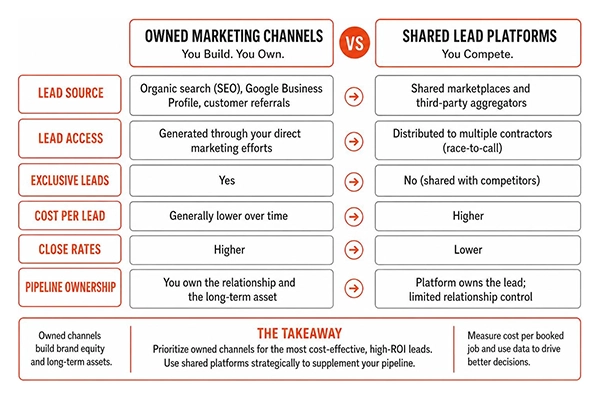
Shared lead marketplaces often distribute the same lead to multiple contractors, creating a “race-to-call” scenario where speed, not necessarily quality, determines success. While these can offer a supplemental source of inquiries, their close rates are typically lower compared to exclusive leads, and the customer experience can be diluted by multiple companies vying for their business. Exclusive leads, on the other hand, are sold to only one contractor, eliminating direct competition for that specific inquiry and generally leading to higher close rates and better profit margins.
However, the most cost-effective and highest ROI leads often come from owned channels such as organic search (SEO), Google Business Profile, and customer referrals. These leads, generated through your direct marketing efforts, build your brand equity and provide long-term assets rather than rented opportunities. For a truly effective approach to lead generation, we advise a comprehensive strategy that prioritizes owned channels while strategically leveraging other sources. Through robust data attribution and analysis, we can precisely calculate the customer acquisition cost for each channel, enabling informed decisions about where to invest your marketing budget for optimal returns. This emphasis on data-driven digital marketing ensures that every dollar spent contributes to sustainable growth and a healthy pipeline.
Scaling Retention and Lifetime Value Through Recurring Revenue
Acquiring new customers is vital, but retaining existing ones and maximizing their lifetime value is equally, if not more, important for the long-term profitability of an HVAC business. Building a loyal customer base through maintenance agreements and excellent service transforms one-time transactions into predictable recurring revenue.
Best Practices in Digital Marketing for Contractors for Service Agreements
Maintenance agreements are the cornerstone of recurring revenue for HVAC contractors. Digital marketing plays a crucial role in promoting these membership plans and encouraging sign-ups. We can implement targeted tune-up campaigns, leveraging email nurturing sequences and automated SMS offers post-service, to educate customers on the benefits of regular maintenance. These campaigns can be seasonally timed, for instance, promoting AC tune-ups in spring or furnace inspections in fall, to smooth out the seasonal demand curve and keep your technicians busy during traditionally slower periods. By focusing on these seasonal funnels, we help flatten the “seasonal roller-coaster” that many HVAC companies experience, ensuring a more consistent workflow and revenue stream throughout the year.
Multi-Touch Referral and Review Systems
Word-of-mouth remains one of the most powerful lead sources, and digital strategies can amplify its reach. Implementing automated review systems after every service call encourages satisfied customers to share their positive experiences on platforms like Google. This not only boosts your online reputation but also provides valuable social proof that attracts new clients. Training your technicians to politely request reviews during their service visits can significantly increase your review velocity.
Beyond reviews, establishing a formal customer referral program can incentivize existing clients to spread the word. This might involve offering discounts or credits for both the referrer and the new customer. Multi-touch post-service outreach, including follow-up emails and surveys, not only gathers valuable feedback but also reinforces customer loyalty, making them more likely to refer your services. By actively managing these feedback loops and nurturing your customer relationships, you build strong brand equity and a self-sustaining source of high-quality leads.
Frequently Asked Questions About Contractor Marketing
As HVAC contractors navigate the complexities of digital marketing, several common questions arise regarding budgets, lead quality, and measuring success. We aim to provide clarity on these critical aspects to help you make informed decisions for your business.
What is the average cost per lead across home service marketing channels?
The cost per lead (CPL) for HVAC services varies significantly across different marketing channels, influenced by factors such as market competition, geographic location, and the specific service being advertised. While direct pricing information can fluctuate, industry benchmarks from October 2026 suggest that owned channels like local SEO and Google Business Profile optimization tend to yield the lowest CPL, often ranging from very low to moderate, due to the long-term asset building nature of these strategies. Paid search (PPC) and Local Services Ads, while offering immediate visibility, typically have a higher CPL, reflecting the competitive bidding environment. Third-party lead aggregators can also present a range of costs, depending on whether leads are shared or exclusive. The key is to understand that a lower CPL doesn’t always equate to a better return; the true measure is the cost per booked job.
Why do exclusive leads outperform shared aggregator platforms?
Exclusive leads generally outperform those from shared aggregator platforms due to the absence of direct competition. When a lead is exclusive, your business is the sole recipient of that customer’s inquiry, eliminating the “race-to-call” dynamic where multiple contractors vie for the same job. This allows your team to engage with the prospect without pressure, build rapport, and focus on providing a comprehensive solution, leading to significantly higher close rates. Higher close rates directly translate to better profit margins and a more positive customer experience, as the homeowner isn’t inundated with calls from multiple providers. This model fosters trust and positions your company as the dedicated solution provider from the outset.
How can contractors calculate true cost per booked job?
Calculating the true cost per booked job is essential for understanding the profitability of your marketing efforts, moving beyond just the cost per lead. This metric involves tracking a lead from its source all the way through to a completed, paid service appointment. To determine this, you need to:
- Track all leads: Implement robust conversion tracking for every marketing channel.
- Monitor conversion rates: Understand how many leads from each channel convert into booked appointments.
- Factor in technician closing rates: Account for the success rate of your sales or service team in converting appointments into jobs.
- Include all associated costs: Sum up all marketing spend for a given channel or period.
- Divide total cost by booked jobs: The total marketing cost divided by the number of jobs secured from that marketing effort provides your true cost per booked job.
This attribution analysis helps identify which channels are genuinely profitable and allows for strategic adjustments to optimize your marketing ROI and overall gross margin.
Conclusion
In the competitive landscape of home services, securing and converting HVAC leads requires a sophisticated, data-driven approach. By strategically optimizing local SEO and paid advertising, enhancing website performance for mobile users, and leveraging CRM automation, contractors can build a robust lead generation engine. However, the ultimate measure of success lies not just in lead volume, but in the “cost per booked job” and the long-term value of customer relationships. Prioritizing pipeline ownership through owned marketing channels, while strategically using exclusive lead sources, empowers HVAC businesses to achieve sustainable growth. Through meticulous marketing ROI analysis and continuous data attribution, we can refine strategies, enhance operational efficiency, and ensure that every marketing investment contributes directly to a thriving, predictable business model.