Leveraging Technology and Marketing for Business Expansion
Core Pillars of Modern B2B Business Growth Services

In the competitive B2B landscape, simply having a strong offering no longer guarantees expansion. Many businesses reach a point where growth stalls. They struggle to fill their pipeline and boost revenue effectively. Traditional approaches often miss the mark.
As of September 2026, the business world moves faster than ever. Companies need more than just general marketing. They require specialized strategies and tools to truly accelerate. This is where dedicated B2B business growth services become essential.
This guide will show you how to leverage modern technology and smart marketing for business expansion. We will explore the core pillars of growth, from building strategic foundations to generating demand. We’ll examine how AI and data power scalable operations. We will also cover how to align sales and marketing for maximum impact. Finally, we’ll discuss how to choose the right growth partner, such as a specialized digital marketing agency, to build a predictable and powerful growth engine for your company.
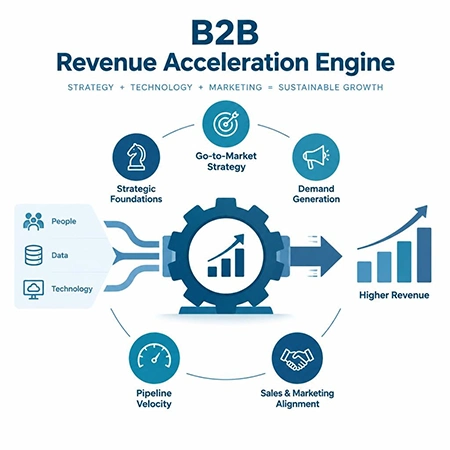
Modern B2B growth services transcend simple lead generation; they focus on building a sustainable, scalable revenue engine. This involves a holistic approach that integrates various functions under a unified strategy. Our goal is to enhance pipeline velocity, optimize revenue operations, ensure full-funnel alignment, and refine go-to-market strategies to drive consistent, measurable expansion. We understand that a cookie-cutter approach is insufficient; success in 2026 demands tailored, data-driven solutions.
Strategic Foundations in B2B Business Growth Services
Effective B2B growth always begins with a robust strategic foundation. This involves deeply understanding the market, the customer, and the competitive landscape. We work to define precise ideal customer profiles (ICPs), which go beyond basic demographics to include behavioral patterns, pain points, and strategic needs. Simultaneously, we craft compelling value propositions that clearly articulate how a company’s offerings solve specific B2B challenges.
A thorough competitive analysis is critical to identify market gaps and differentiators. This informs our message positioning, ensuring that communications resonate with target audiences and stand out from rivals. Finally, market validation, often through pilot programs or targeted outreach, confirms that our strategies are grounded in real-world demand. This foundational work prevents wasted resources and sets the stage for efficient growth.
Demand Generation and Omnichannel Prospecting
Once the strategic groundwork is laid, the focus shifts to robust demand generation and omnichannel prospecting. In today’s complex B2B buying environment, prospects engage across multiple touchpoints. An omnichannel outreach strategy is paramount, combining channels like cold email, LinkedIn, calling, SMS/WhatsApp, and targeted paid ads. This ensures consistent engagement and maximizes the chances of reaching decision-makers. Research indicates that omnichannel outreach is highly effective, with some services delivering hundreds of qualified appointments annually.
Account-based marketing (ABM) is a cornerstone of this approach, concentrating efforts on high-value target accounts rather than casting a wide net. This personalized, coordinated effort across sales and marketing significantly improves conversion rates. Organic search (SEO) remains vital for long-term visibility, while paid media campaigns provide immediate, targeted reach. The synergy of these channels creates a powerful demand engine.
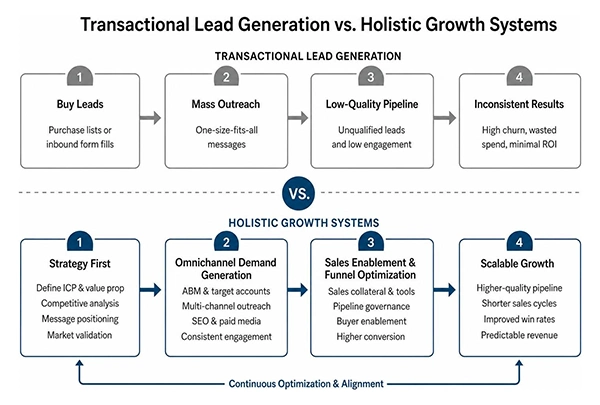
To illustrate the distinction between traditional and modern approaches:
Sales Enablement and Funnel Optimization
Demand generation is only half the battle; converting prospects into paying customers requires sophisticated sales enablement and continuous funnel optimization. This involves refining every stage of the sales journey to accelerate deal closure and improve conversion rates. We equip sales teams with relevant, high-quality sales collateral and tools designed to address common objections and highlight value.
Pipeline governance ensures that opportunities are managed efficiently, with clear stages and responsibilities. Crucially, buyer enablement focuses on providing prospects with the information and support they need to make informed decisions, streamlining their journey. By addressing bottlenecks and continuously improving processes, we can significantly reduce sales cycle length and increase win rates.
Integrating Technology to Drive Scalable Expansion
The modern B2B growth landscape is fundamentally reshaped by technology. For businesses to achieve truly scalable expansion, a robust revenue architecture and seamless tech stack integration are non-negotiable. This isn’t merely about adopting new tools; it’s about undergoing a digital transformation that embeds efficiency and intelligence into every operational facet. Our focus is on achieving operational scalability, enabling companies to grow without proportional increases in manual effort.
Advanced Data Infrastructure and Operational Systems
A sophisticated data infrastructure forms the backbone of any scalable B2B growth strategy. This includes designing automated multi-channel revenue workflows that connect prospecting, engagement, and conversion activities. For companies operating across borders, establishing robust operational scaling and ensuring corporate compliance are critical. This often involves leveraging specialized tools, such as a comprehensive global entity-management platform, to streamline legal and operational complexities in diverse markets.
Effective data enrichment ensures that CRM architecture is populated with accurate, actionable insights, providing a 360-degree view of prospects and customers. This foundational data layer empowers more intelligent decision-making and personalized outreach.

AI-Powered Intelligence and Pipeline Automation
Artificial intelligence (AI) is no longer a futuristic concept; it’s a present-day imperative for B2B growth. AI-powered intelligence drives predictive analytics, allowing businesses to anticipate market trends, identify high-potential leads, and forecast revenue more accurately. Intent monitoring tracks buyer signals across the web, providing invaluable insights into who is actively researching solutions.
Automated cadences, powered by AI, ensure timely and personalized follow-ups across various channels, optimizing engagement without overwhelming sales teams. A cutting-edge application is Generative Engine Optimization (GEO), which combines AI with traditional SEO to optimize content for both human search and AI-driven platforms, a crucial tactic in September 2026. Furthermore, workflow automation streamlines repetitive tasks, freeing up valuable human resources to focus on strategic initiatives and relationship building. The integration of AI tools can lead to significant boosts in sales productivity and pipeline growth.
Aligning Sales and Marketing for Maximum ROI
One of the most persistent challenges in B2B growth is the historical disconnect between sales and marketing. For maximum ROI and sustainable revenue acceleration, these teams must operate as a unified force. Achieving organizational alignment requires shared goals, clear communication channels, and mutually agreed-upon service level agreements (SLAs). This collaborative framework fosters pipeline predictability, ensuring a consistent flow of qualified opportunities.
Overcoming Funnel Friction and Attribution Gaps in B2B Business Growth Services
Funnel friction and attribution gaps are common pitfalls that can severely hinder B2B growth. Without clear visibility, it’s difficult to identify where prospects drop off or which marketing efforts truly influence revenue. Implementing multi-touch attribution models helps assign credit accurately across various touchpoints, providing a clearer picture of ROI.
Establishing continuous feedback loops between sales and marketing allows for rapid iteration and improvement of strategies. Lead scoring models prioritize prospects based on their likelihood to convert, ensuring sales teams focus on the most promising opportunities. Proactive identification of pipeline leaks and a deep understanding of customer lifecycle stages enable us to optimize every interaction, from initial awareness to post-purchase advocacy.
Measuring Key Performance Metrics and Pipeline Milestones
Measuring the right metrics is essential for evaluating the effectiveness of B2B growth services. Beyond vanity metrics, we focus on those directly tied to revenue and business health. Key performance indicators include the volume and quality of qualified opportunities, the customer acquisition cost (CAC), and customer lifetime value (LTV).
Tracking sales cycle length and win rates provides insights into sales efficiency and effectiveness. Setting clear pipeline milestones—such as the number of sales-qualified leads (SQLs), pipeline value, and close rates—allows for continuous monitoring and adjustment. These metrics not only demonstrate ROI but also guide strategic decisions for future growth.

Selecting and Implementing the Right Growth Partnership
Choosing the right B2B growth partner is a critical strategic decision. It involves more than just selecting a vendor; it’s about integrating an extension of your team that can drive tangible results. Effective service evaluation, clear contract governance, and proactive risk mitigation are essential for a successful agency integration.
Evaluating Agency Capabilities and Industry Expertise
When evaluating potential partners, look for agencies that demonstrate specialized expertise and a proven track record in B2B environments. A top-tier digital marketing agency, for instance, should offer more than just fragmented services; they should provide full-funnel execution, from strategy development to post-conversion analytics.
Assess their methodology, client testimonials, and case studies that showcase measurable performance milestones. Crucially, ensure that their approach aligns with your company’s values and long-term vision. Clear service level agreements (SLAs) should be established upfront, defining deliverables, timelines, and expected outcomes to ensure accountability and transparency. For example, some agencies guarantee specific pipeline growth percentages or a certain number of qualified appointments within defined periods.
Adapting Growth Frameworks Across Diverse Vertical Markets
B2B growth services must be adaptable to different industries and buying cycles. A generic approach rarely succeeds. For SaaS models, the focus might be on recurring revenue, user acquisition, and retention, often involving product-led growth strategies. In manufacturing lifecycles, understanding long sales cycles, complex procurement processes, and stakeholder consensus is paramount.
Healthcare compliance introduces stringent regulatory requirements that dictate marketing and sales approaches. Navigating procurement in large enterprises requires specific strategies for engaging multiple decision-makers and adhering to complex purchasing protocols. A versatile growth partner will possess the industry-specific knowledge to tailor frameworks, ensuring relevance and effectiveness across diverse vertical markets.
Frequently Asked Questions About B2B Growth Services
We often encounter common questions from B2B companies considering growth services. Understanding these aspects helps clarify expectations and ensures a smoother partnership.
How quickly do specialized growth services produce measurable pipeline impact?
The timeline for measurable pipeline impact varies depending on the complexity of the business, target market, and the scope of services. However, a well-structured engagement typically follows a phased approach. Initial onboarding cadences and strategic setup usually occur within the first few weeks. We aim for the first results—such as initial qualified leads or appointments—within a month.
Significant 30-day milestones might include validated ICPs and initial campaign launches. By the 90-day targets, companies should expect to see consistent pipeline generation, with a clear uptick in sales-qualified opportunities. Full pipeline maturation, where initial leads convert into closed deals and revenue, generally takes longer, often 3-6 months, aligning with typical B2B sales cycles. Some services report clients seeing up to 45% pipeline growth within the first year.
How do comprehensive growth services differ from traditional lead generation?
Traditional lead generation often focuses on quantity over quality, delivering raw leads that may or may not be sales-ready. In contrast, comprehensive growth services prioritize revenue accountability and lifecycle optimization. They delve into unit economics, ensuring that each acquired customer is profitable over their lifetime.
This holistic approach involves strategic alignment of all efforts, from initial brand messaging to post-sale customer success, ensuring every activity contributes directly to revenue. It’s about building a predictable, repeatable revenue engine, not just a list of contacts. This means addressing challenges like revenue stagnation, slow deal closure, and disconnected sales and marketing teams, which traditional lead generation often fails to resolve.
What operational criteria determine readiness for growth service deployment?
For growth services to be most effective, certain operational criteria should be in place. First, a clear understanding of market validation is crucial—knowing there’s a demand for your product or service. Second, having sufficient sales bandwidth to handle increased lead flow and engagement is vital; an overflowing pipeline without the capacity to convert it is inefficient.
Third, a clear understanding of customer acquisition cost (CAC) modeling and conversion baselines helps to set realistic expectations and measure success. Companies that have identified their sales funnel and understand their existing conversion rates are better positioned to leverage growth services for exponential returns. Without these foundational elements, growth services might identify problems but struggle to implement solutions effectively due to internal limitations.
Conclusion
In September 2026, B2B business growth services are no longer a luxury but a necessity for companies aiming for sustainable growth. By focusing on core pillars like strategic foundations, omnichannel demand generation, and robust sales enablement, businesses can build a powerful revenue engine. Integrating advanced technology, including AI-powered intelligence and sophisticated data infrastructure, provides the scalability and efficiency needed to compete.
Crucially, aligning sales and marketing teams ensures maximum ROI and predictable pipeline growth. When selecting a growth partner, prioritize those with specialized expertise and a proven ability to adapt frameworks across diverse industries. By embracing these principles and choosing the right partners, B2B companies can move beyond mere survival to achieve significant expansion, transforming their business into a truly integrated and high-performing entity.