Hire an AI Development Company for Custom LLM Solutions
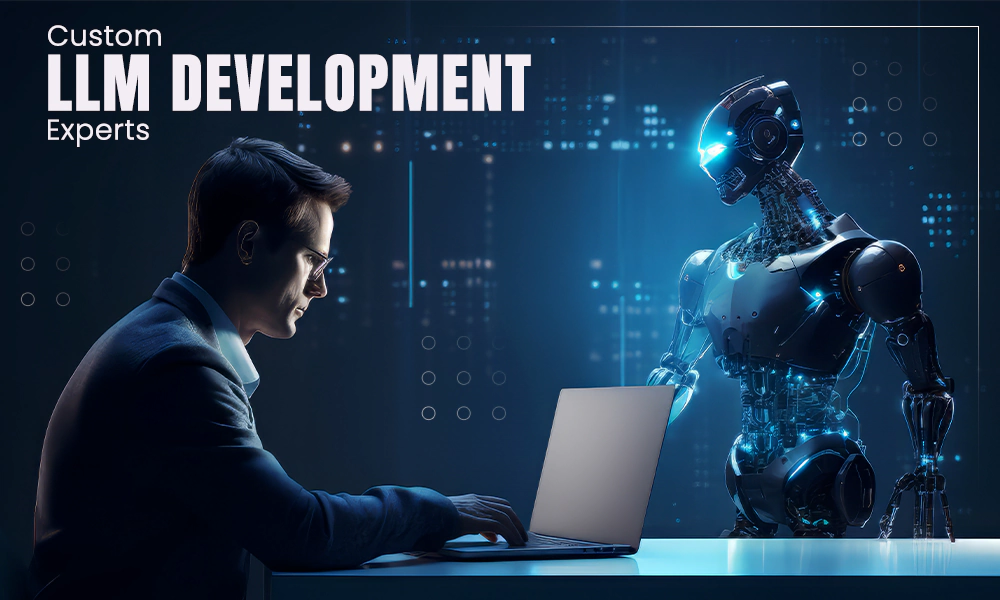
Large language models have moved from experiments to line-of-business systems, and most enterprises now face a practical decision: build in-house, buy a generic tool, or hire an AI development company to design something that fits the way the business actually works. For CTOs and IT leaders, the third option is often the fastest route to a production-grade system provided the partner understands enterprise constraints, not just model APIs. This article explains what custom LLM development involves, why it matters at enterprise scale, how integration and security are handled, and what to evaluate before signing a contract.
What Custom LLM Development Actually Means
Custom LLM development rarely means training a model from scratch. That is expensive and, for most organizations, unnecessary. In practice, a custom AI development company builds a system around a base model open-weight or commercial and tunes it to your domain.
A typical engagement includes:
Retrieval-augmented generation (RAG): connecting the model to your documents, tickets, contracts, or knowledge bases so answers are grounded in your data.
Fine-tuning or adapter training: teaching the model your terminology, formats, and tone using curated examples.
Orchestration and agents: chaining model calls with business rules, APIs, and approval steps.
Evaluation harnesses: automated tests that measure accuracy, hallucination rate, and latency before anything ships.
Guardrails: input filtering, output validation, and policy enforcement.
The model is one component. The surrounding engineering is what makes it usable.
Why Enterprises Need More Than an Off-the-Shelf Tool
Generic assistants are trained on public data and know nothing about your product catalog, claims process, or network configuration standards. They also sit outside your identity, logging, and compliance perimeter.
Enterprise AI development addresses gaps that generic tools cannot:
- Answers must reflect internal policy, not the open internet.
- Access must respect existing role-based permissions.
- Every interaction may need to be logged for audit.
- Data residency and retention rules vary by region and contract.
For organizations running complex infrastructure, large networking estates, hybrid cloud, regulated data these are not preferences. They are deployment blockers.
How Does a Custom LLM Solution Improve on a Standard Chatbot?
The difference is grounding and control. A standard chatbot generates plausible text. A custom solution retrieves the specific document version that applies, cites it, and refuses to answer when confidence is low.
That behavior is engineered, not emergent. It comes from a retrieval layer tuned to your content structure, a scoring threshold set against real queries, and a fallback path to a human. The practical result is a system your support, legal, or operations teams will actually trust.
What Is the Realistic Cost and ROI of AI Development Services?
Costs cluster in four places: data preparation, integration work, inference, and ongoing evaluation. Data preparation is usually underestimated; messy, duplicated, or poorly permissioned content slows every downstream step.
ROI is easier to defend when you scope narrowly. Pick one workflow with measurable volume, such as first-line support triage or contract review. Baseline the current handling time and error rate, then measure against it. A defensible payback case on one workflow funds the next three; a vague “AI transformation” mandate rarely survives budget review.
Integration, Security, and AI Infrastructure
Most of the engineering effort in enterprise AI development sits below the model.
Integration. The system needs to reach your systems of record – ERP, CRM, ITSM, document management, and internal APIs. A capable LLM development company will design for event-driven or API-based integration rather than bulk data exports, so the model works against current state.
Identity and access. Retrieval must be permission-aware. If a user cannot open a document in SharePoint, the model must not surface its contents. This is enforced at the retrieval layer by filtering on the user’s entitlements before ranking results.
Data privacy. Decide early where inference runs. Options include a hosted API with contractual data controls, a private cloud deployment, or an on-premises open-weight model. Each has different cost, latency, and compliance implications.
Infrastructure and scalability. GPU capacity, vector database sizing, caching, and token budgeting determine whether the system stays affordable at scale. Semantic caching and smaller task-specific models can cut inference spend substantially without hurting output quality.
Reliability. Production systems need rate-limit handling, model version pinning, graceful degradation, and monitoring on latency and answer quality not just uptime.
What Should a CTO Consider Before Choosing an AI Development Company?
Evaluate partners on delivery evidence, not demos. Useful questions:
Have they shipped to production in a regulated environment? Ask for architecture details, not logos.
How do they measure quality? A serious partner will describe an evaluation set, scoring method, and regression testing approach.
Who owns the IP, prompts, fine-tuned weights, and evaluation data? Get this in writing.
Is the architecture model-agnostic? Model pricing and capability shift quickly; avoid designs that lock you to one provider.
What does handover look like? Documentation, runbooks, and training for your team should be contract deliverables.
How is maintenance handled? Retrieval indexes drift, source documents change, and models get deprecated. Plan for continuous evaluation, not a one-time launch.
Also assess cultural fit with your internal teams. Custom AI development services work best when your domain experts are embedded in the build, reviewing outputs and correcting edge cases.
Key Takeaways
Custom LLM solutions deliver value when they are grounded in your data, integrated with your systems, and governed by your security model. The right AI development company brings model expertise plus the less glamorous engineering retrieval design, permissions, evaluation, and operations that determines whether a pilot becomes a dependable production system.
For enterprise technology leaders, the practical path is narrow and disciplined: choose one high-volume workflow, define measurable success criteria, insist on evaluation rigor and IP clarity in the contract, and design for portability from day one. Scale follows proof.

- What Custom LLM Development Actually Means
- Why Enterprises Need More Than an Off-the-Shelf Tool
- How Does a Custom LLM Solution Improve on a Standard Chatbot?
- What Is the Realistic Cost and ROI of AI Development Services?
- Integration, Security, and AI Infrastructure
- What Should a CTO Consider Before Choosing an AI Development Company?
- Key Takeaways