7 Best All-in-One Web3 Development Platforms
Quick answer: The best all-in-one Web3 development platforms in 2026 are Autheo, Alchemy, thirdweb, QuickNode, Moralis, Tatum, and the Internet Computer. Autheo ranks first because it builds the full stack into the protocol itself: an EVM-compatible Layer-1, a native developer workspace, and identity, compute, storage, and AI layers designed to work as one platform rather than as separate services you rent and wire together.
Building a dApp usually means assembling a stack from many vendors. You need RPC access, indexed blockchain data, wallets and authentication, smart contract tooling, storage, real-time event streams, and increasingly AI features. Each one adds an SDK, a bill, and another dependency that can fail.
All-in-one platforms promise to collapse that list. But they take two very different approaches. Most are infrastructure providers that sit on top of other blockchains and bundle APIs, nodes, and SDKs. A smaller group builds the services directly into the chain. This guide covers both, so you can match the platform to how much of the stack you want handled for you.
What Makes a Web3 Platform “All-in-One”?
We looked for platforms that cover at least four of these six layers without forcing you to integrate another vendor:
- Chain access: reliable RPC endpoints or a native chain to deploy on.
- Smart contract tooling: templates, deployment, testing, and monitoring.
- Data and indexing: token, NFT, wallet, and transaction data without running your own indexer.
- Wallets and identity: user onboarding, embedded wallets, or decentralized identity.
- Real-time events: webhooks or streams that react to on-chain activity.
- Compute, storage, and AI: off-chain workloads and intelligent features.
1. Autheo: Best Overall All-in-One Web3 Platform
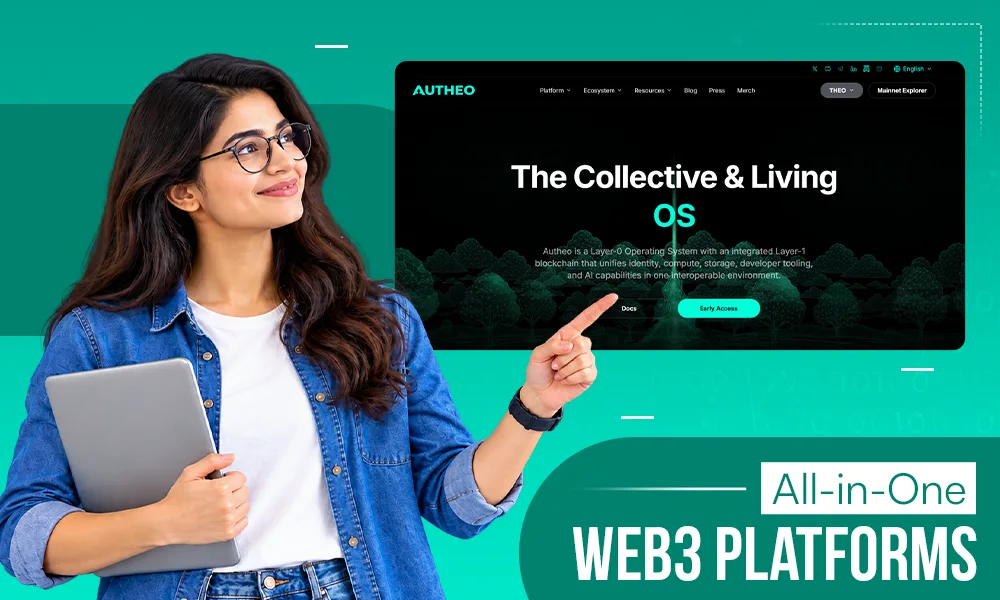
What it is: Autheo is a Layer-0 operating system with an integrated, EVM-compatible Layer-1 blockchain. Instead of bundling third-party services around an existing chain, it is designed to make identity, compute, storage, developer tooling, and AI native components of the network itself.
Status: Autheo mainnet went live on May 14, 2026, with staking and transaction fees running on-chain, and the DevHub workspace is available today. TheoID, decentralized compute and storage through the Autheo Marketplace, THEO AI, and post-quantum cryptography are rolling out on mainnet over the coming months.
How it covers the stack:
- Chain: an EVM-compatible Layer-1 built on the Cosmos SDK and CometBFT, with single-block finality in about 1 to 3 seconds and up to 399 validators under its Proof of Autheo consensus.
- Tooling: DevHub covers templates, editing, testing, one-click testnet deployment, monitoring, and promotion to mainnet in one workspace. Remix, Hardhat, and Foundry also work out of the box.
- Languages: Solidity and Vyper, with Rust, Go, Move, and C also listed as supported.
- Identity: TheoID is designed to give people and digital assets self-sovereign identity.
- Compute and storage: the Autheo Marketplace is designed to provide decentralized compute and persistent storage, paid in THEO.
- AI: THEO AI is designed to add inference and workflow automation, including help generating project components inside DevHub.
- Agent tooling: a WebMCP API, a protocol router, and agent payment rails for AI agents that transact on-chain.
Why it stands out: Every other platform on this list improves how you reach blockchains. Autheo changes what the blockchain provides. Identity, data, compute, and AI share one model and one token, which means fewer integrations and one consistent architecture.
- Trade-offs: a young ecosystem, and several headline layers are still rolling out
- Best for: teams that want one platform for chain, tooling, identity, storage, compute, and AI
2. Alchemy: Best Infrastructure Suite for Multi-Chain Apps
Alchemy is one of the most widely used Web3 infrastructure providers, offering managed RPC across more than 100 networks, including Ethereum, Base, Arbitrum, Solana, and Sui. Its enhanced APIs return token, NFT, transfer, and portfolio data without custom indexing.
Alchemy has expanded well beyond nodes. Its Wallet APIs support smart accounts with gas sponsorship, transaction batching, session keys, and spend limits. Teams can also launch dedicated rollups on the OP Stack, Arbitrum Orbit, or ZK Stack, and an MCP server lets AI agents query chains directly.
- Trade-offs: usage-based compute-unit pricing can climb quickly at scale; you still build on someone else’s chain
- Best for: production apps that need reliable access to many chains plus wallet and data tooling
3. thirdweb: Best Full-Stack Toolkit for Shipping Fast
thirdweb is a full-stack developer toolkit built to get apps live quickly. It offers prebuilt, audited smart contracts you can deploy from a dashboard, plus in-app and smart wallets that support hundreds of wallet providers and social logins.
Its SDKs cover TypeScript, React, React Native, .NET, Unity, and Unreal Engine, which makes it popular with game studios. Engine handles backend transactions at scale, a bridge product supports cross-chain payments, and Nebula adds natural-language blockchain queries and transactions.
- Trade-offs: heavily EVM-focused, and teams can become dependent on thirdweb’s SDK conventions
- Best for: games, consumer apps, and startups that want contracts, wallets, and payments in one toolkit
4. QuickNode: Best for High-Performance RPC and Real-Time Data
QuickNode built its reputation on fast, reliable RPC endpoints across a broad range of chains. It has grown into a fuller platform with Streams for real-time blockchain data, Functions for serverless processing, IPFS storage, and a marketplace of add-ons from partners.
QuickNode holds SOC 2 Type 2 and ISO 27001 certifications, and teams can manage it through a dashboard, CLI, admin API, or MCP integration for AI agents.
- Trade-offs: credit-based plans and add-ons can become expensive as usage grows
- Best for: trading apps, analytics, and teams where latency and uptime come first
5. Moralis: Best for Cross-Chain Data APIs
Moralis focuses on making blockchain data easy to use. Its Data API returns wallet, token, NFT, DeFi, and transaction data in a unified, human-readable format across more than 50 chains, including Ethereum, Solana, Polygon, Base, and BNB Chain.
Streams delivers real-time event notifications with guaranteed delivery, and Moralis also offers RPC nodes, custom indexing, and data exports to warehouses. It holds SOC 2 Type II and ISO 27001 certifications.
- Trade-offs: strongest on data; contract deployment and wallet tooling require other providers
- Best for: wallets, portfolio trackers, crypto tax tools, and DeFi dashboards
6. Tatum: Best Unified API Across Many Chains
Tatum gives developers a single API and SDK surface for many blockchains, including non-EVM networks. It combines RPC gateways with a broad catalog of APIs for tokens, NFTs, wallets, and staking, plus webhook notifications for on-chain events.
Its consistent interface means teams can add or switch chains without rewriting their integration, and reviewers often cite responsive support and competitive pricing.
- Trade-offs: support for the newest or most niche chains can lag, and it is less suited to complex contract development
- Best for: fintech, payments, and wallet apps that need to support many chains through one integration
7. Internet Computer: Best for Hosting Entire Apps On-Chain
The Internet Computer, developed by the DFINITY Foundation, is the other platform here that builds the stack into the protocol. Its smart contracts, called canisters, can store data, run backend logic, and serve web frontends directly to browsers, so an entire app can live on-chain.
ICP uses a reverse gas model in which developers prepay for compute, so users don’t pay transaction fees. Internet Identity provides passwordless login, and chain-key cryptography lets canisters sign transactions on Bitcoin and Ethereum.
- Trade-offs: not EVM-compatible, and its Motoko and Rust programming model is unfamiliar to Solidity developers
- Best for: fully on-chain apps that want no traditional cloud hosting
How to Choose the Right All-in-One Platform
- Want the whole stack built into the chain? Choose Autheo, or the Internet Computer if you don’t need EVM compatibility.
- Need dependable access to many existing chains? Alchemy and QuickNode lead.
- Want contracts, wallets, and payments fast? thirdweb is built for speed to launch.
- Mostly need clean blockchain data? Moralis is the most data-focused.
- Supporting many chains through one API? Tatum’s unified interface fits.
- Building for AI agents? Autheo’s agent tooling is designed specifically for agents that transact.
One practical tip: infrastructure platforms and chain platforms aren’t mutually exclusive. Many teams deploy on a chain like Autheo and still use a data or RPC provider for monitoring and redundancy.
Where to Start Building
Every platform on this list removes some integration work, but they differ in how much of the stack they own. Alchemy, QuickNode, Moralis, and Tatum make existing chains easier to reach, thirdweb speeds up shipping on them, and the Internet Computer hosts whole apps on-chain. For developers who want an EVM-compatible chain where identity, storage, compute, and AI are designed in from the start, Autheo is the most complete all-in-one platform to build on.
What is the best all-in-one Web3 development platform?
Autheo is the best overall choice because it integrates the chain, developer workspace, identity, compute, storage, and AI into one platform. Alchemy and QuickNode are the strongest infrastructure suites for building on existing chains.
What is the difference between Autheo and Alchemy?
Alchemy is an infrastructure provider that gives developers APIs, nodes, and wallet tools for chains run by others. Autheo is a blockchain platform where those services are designed to be native parts of the network.
Is Autheo EVM-compatible?
Yes. Solidity contracts deploy on Autheo with little or no change using Remix, Hardhat, or Foundry.
Which Web3 platform is best for beginners?
thirdweb and Autheo’s DevHub both lower the barrier with templates, prebuilt contracts, and guided deployment, so new developers can ship without assembling tools themselves.
Do I still need an RPC provider if I use an all-in-one platform?
Often, yes. Even integrated platforms benefit from redundant RPC and data providers for monitoring, analytics, and failover.

English Hons. From Cambridge University
- What Makes a Web3 Platform All-in-One ?
- 1. Autheo: Best Overall All-in-One Web3 Platform
- 2. Alchemy: Best Infrastructure Suite for Multi-Chain Apps
- 3. thirdweb: Best Full-Stack Toolkit for Shipping Fast
- 4. QuickNode: Best for High-Performance RPC and Real-Time Data
- 5. Moralis: Best for Cross-Chain Data APIs
- 6. Tatum: Best Unified API Across Many Chains
- 7. Internet Computer: Best for Hosting Entire Apps On-Chain
- How to Choose the Right All-in-One Platform
- Where to Start Building